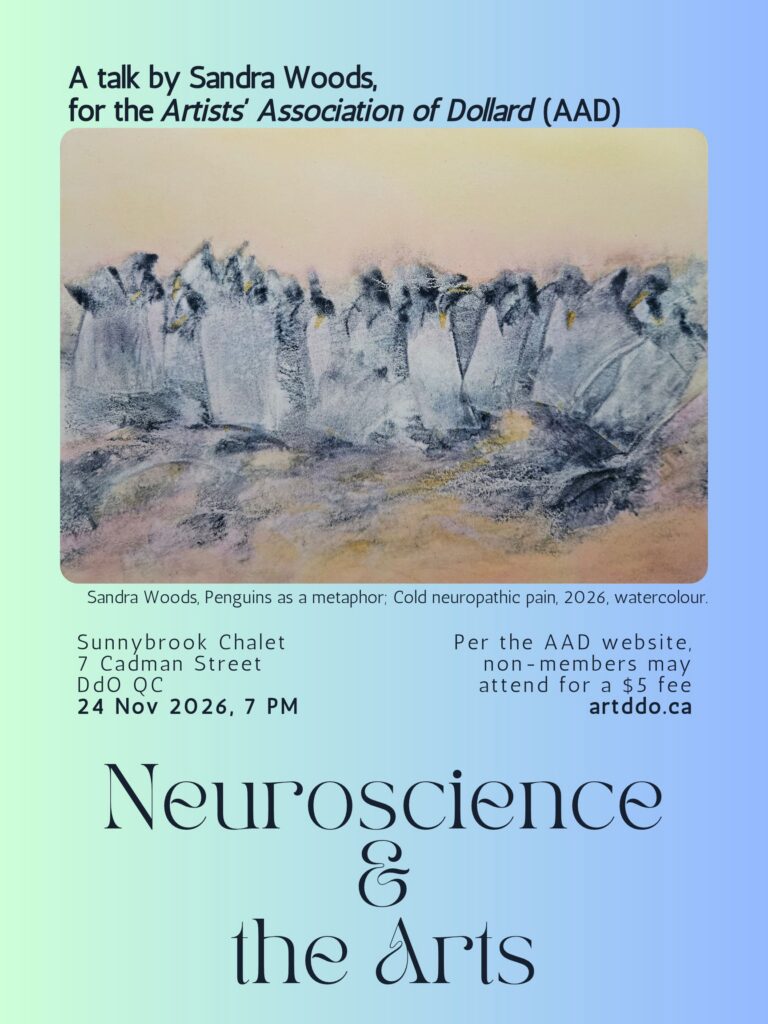
In a few weeks I’ll be giving a talk that combines my bioethics and research ethics background with my experience as a volunteer Patient Partner and co-author in research in the areas of chronic pain and neuroscience – along with my newer adventures as a Professional Artist using my art practice to improve my own brain’s neuroplasticity.
I’ve just agreed to be the guest speaker for a local artists’ association here in Montreal, on November 24, where I’ll present a one-hour talk on “Neuroscience & the Arts”. I’m not naming the organization, because they haven’t made the announcement to their members!
I chose this topic as I began learning to paint five years ago because of neuroscience research into the potential benefits of the arts on two issues resulting from of one of my two rare diseases; chronic pain, and the midlife-onset Mild Cognitive Impairment that ended my bioethics career at the end of 2018.
I’ve often been asked by other artists about how medical research led me to begin learning to paint, then to become a Professional Artist (under both the federal Canada Council for the Arts and the much more stringent provincial Regroupement des artistes en arts visuels du Québec (RAAV), so this seemed like the perfect opportunity to answer that question.
And to be perfectly honest, there’s a lot of neuroaesthetics and neuro-arts research out there that is likely to be very interesting to anyone interested in the arts.
I’m already kicking around ideas of how to structure this presentation, leaning towards a chronological overview from the first research on neuroscience and the arts that I stumbled across back in 2016 – after being diagnosed with the first of my two rare conditions.
It would probably make sense to also include the story of how I got involved in pain research in 2016 as a volunteer Patient Partner with new-onset severe chronic pain. With my background in bioethics and clinical or medical research ethics, I already had an affinity for research, which led to co-authoring several research papers – with more currently being prepared for publication. As pain research is often neuroscience research, by 2016 I was already keeping abreast of pain-related ‘brain science’.
Then there seemed to be a surge of in research investigating the arts as potential non-pharmacological approaches to chronic pain management by 2018, which intrigued me and led to my involvement with the “Play the Pain” project and a two-day series of drop-in workshops in Montreal on pain management techniques including art therapy, creative writing, game-playing, humour, music therapy, virtual reality simulations, yoga, and more.
By this time I’d developed the Mild Cognitive Impairment that ended my bioethics career, triggering a greater interest in neuroscience research in the areas of cognition and memory – which led me to begin learning to paint in 2021 as a way to increase my own neuroplasticity or brain-plasticity.
If you’re in the Montreal area and would like to attend, all the information is on the poster!