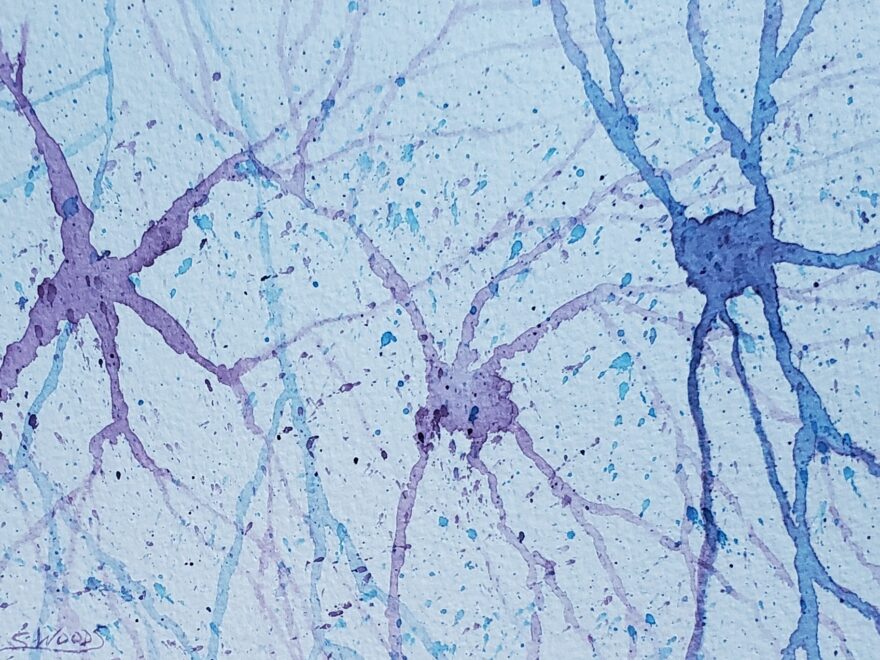
If you’ve been following along with me on this wild ride from bioethics and research ethics professional to Patient Partner – living with severe chronic pain and a Mild Cognitive Impairment from the same rare disease – then you’ll know that along the way I’ve also become an artist.
I’d never painted nor done any drawing or sketching before I developed a pain condition. My background is in research, and when I was diagnosed with CRPS (Complex Regional Pain Syndrome formerly named Reflex Sympathetic Dystrophy or RSD) in 2016, I quickly became involved with pain research; helping researchers study pain, as I already understood how medical research is conducted.
At the end of 2019, if I recall correctly, I started seeing research suggesting that both appreciating art – like going to a museum or a play – and creating art could help people with chronic pain and cognitive impairment; I have both.
Also in 2019, I became a Patient Partner for the Play the Pain project – including a two-day public drop-in event in downtown Montréal.(2)
I’d always wanted to learn how to paint, since I was a child; my grandfather was an accomplished pastel artist, and my grandmother loved museums. She took me to museums from the time I was in kindergarten, and for some reason I adored watercolour paintings. So, I thought to myself: “If the research is showing this might help, why not try?”
When I started painting in 2021, it was during the pandemic. Suddenly, world-class artists were offering classes online. I didn’t go the YouTube route, instead taking instructor-led classes, and I absolutely fell in love with watercolour.
Once my paintings started getting into exhibitions, I realized that they could communicate about pain in ways that we’re stronger than words – which was the start of my Art Despite Pain initiative. #ArtDespitePain uses my artwork to raise awareness of chronic pain conditions and shares my art practice to encourage others living with persistent pain to try creative pursuits to improve their symptoms and possibly even their quality of life.
And I’ve become involved in projects bridging the arts and pain, as well.
So I was thrilled to see this fantastic paper published this month: “The Public Value of Arts and Culture”, from the Institute for Innovation and Public Purpose (IPPP) at University College London (UCL).
“Arts and culture, from visual arts to music and design, are the foundations for reimagining alternative futures, fostering civic identity, and mobilising collective action. Yet they remain underutilised and undervalued in economic policy.
Arts and culture are not peripheral to economic a development but essential to both stimulating and directing economic growth toward more creative, inclusive and sustainable societies and generating high economic multipliers and dynamic spillovers across the economy and society.
We need to move away from viewing arts and culture as a cost and towards recognising them as an investment.
Arts and culture can be both a means and an end: a goal of economic policy as well as a precondition for economic transformation.”(1)
There are also proven health and mental health benefits to the arts and culture – as with my own use of an art practice as a neuroplasticity approach to chronic pain management and my Art Despite Pain #artdespitepain initiative.
For the neuroscience behind this approach, watch my TEDtalk-style co-presentation with Dr. Zoha Deldar at PAINtalks 2024: “Solving the Pain Puzzle: How Flow becomes HOPE‘.
As noted in the paper, although the arts have “social or instrumental benefits, including positive externalities such as improved health outcomes, educational attainment and workforce skill…. methods for robustly capturing them in standard policy appraisal processes remain underdeveloped.”(1)
Someday, hopefully we’ll start to see research showing how important the arts are for pain, for mental health, for children’s development, and so much more.
As always, thank you for stopping by. To comment, please reach out on Twitter or BlueSky (@SandraWoodsMtl), as I’ve had to disable Comments here due to high-intensity spam. It got to be too much to deal with, because of my Mild Cognitive Impairment.
Keep well, and stay safe!
References:
(1) Mariana Mazzucato. “The Public Value of Arts and Culture: Investing in Arts and Culture to Reimagine Economic Growth in the 21st Century”. UCL Institute for Innovation and Public Purpose (IIPP): University College London. ePubl Sep 2025:
https://www.ucl.ac.uk/bartlett/publications/2025/sep/public-value-arts-and-culture
(2) Play the Pain. Media Health; Concordia University [Media Health Lab is a collaborative initiative supported by Concordia University PERFORM Centre and The Milieux for Arts, Culture and Technology]. 2019:
https://playthepain.com